
On this page
- What do most Modesto houses get?
- What happens on installation day?
- How does the valley climate shape the job?
- What size suits my house?
- What does new gutter cost?
- What belongs on the written quote?
- Is a license or permit needed?
- What about additions and new construction?
- When is the best time of year?
- Parts of a gutter system
What do most Modesto houses get?
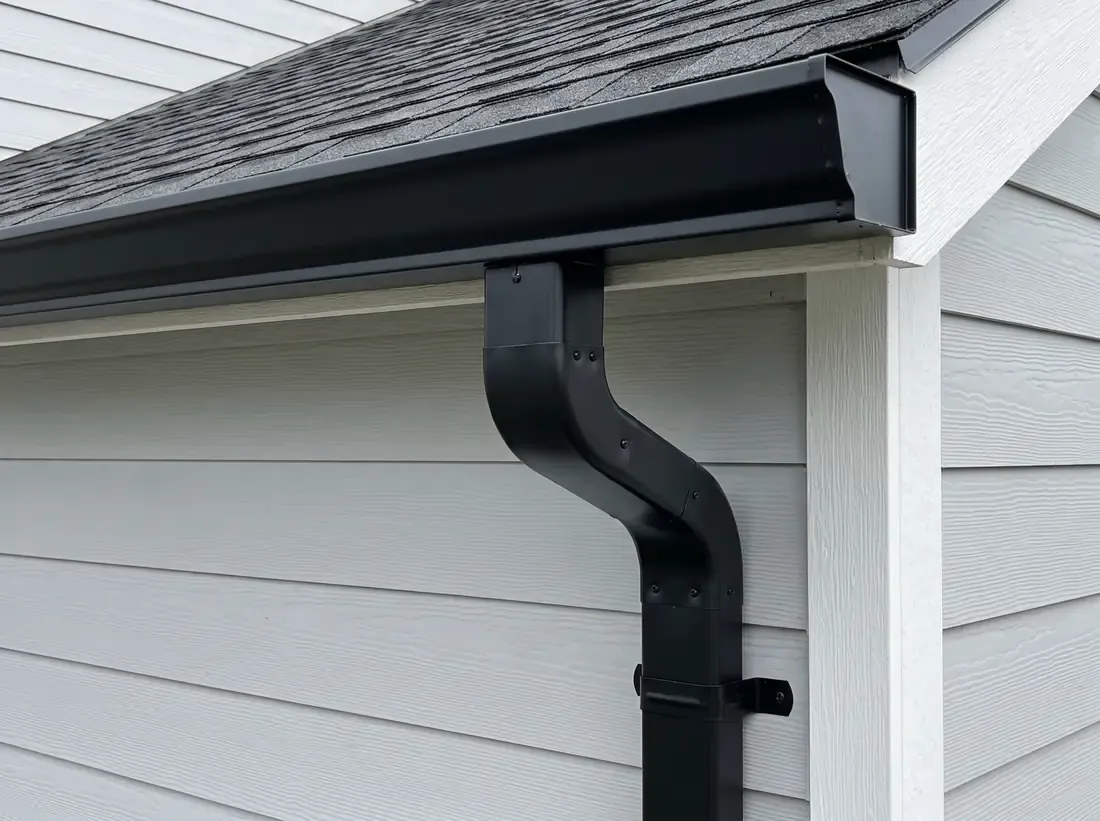
Seamless aluminum in the K-style profile, 5 or 6 inches across, with rectangular downspouts. The installer arrives with painted coil and a roll-former and makes every run at the house, cut to the length of the wall.
| Decision | Usual answer | Reasons to choose otherwise |
|---|---|---|
| Profile | K-style | A pre-1940 house with open eaves often suits half-round |
| Width | 5-inch | Large, steep or valley-cut roofs, or metal roofing: 6-inch |
| Material | Aluminum | Period or custom homes may want copper |
| Joints | Seamless | A small shed or patio cover the machine cannot reach |
| Downspouts | 2x3 on 5-inch, 3x4 on 6-inch | Street trees overhead: 3x4 throughout. See downspouts |
What happens on installation day?
- Survey. Each eave is measured, and outlet points are chosen where water can be carried off the slab.
- Wood test. The fascia is probed along its length. Soft sections are cut out and replaced before any gutter goes up.
- Roof edge. On shingle roofs, a gutter apron is added where drip edge is missing. On tile, the gutter height is set so water leaving the tile lip falls inside.
- Forming. Coil runs through the machine and each length comes out sized to its wall.
- Ground work. End caps and outlet drops are fitted and sealed before lifting.
- Hanging. Hidden hangers go in no more than two feet apart along a line falling about a quarter inch per ten feet.
- Corners. Miters are cut, riveted and sealed from inside.
- Downspouts. Pipe and elbows are strapped to the stucco on masonry anchors and finished with an extension, splash block or buried line.
- Proof. A running hose at the high end shows the fall works and the joints hold.
How does the valley climate shape the job?
Heat first. The valley sees roughly 79 afternoons a year at 90 degrees or hotter, and July averages close to 95. A gutter spends half the year dry under hard sun. Paint fades, sealant stiffens, and aluminum lengthens and shortens every day. Screwed hangers, flexible sealant and few joints are what survive that.
Rain in a short season. Roughly 12 inches a year falls, nearly all between November and March, some of it in heavy bursts. The gutter does nothing for months, then must carry the worst hour of a winter storm.
Flat land, slow soil. The valley floor is level and much of the soil is clay or silty loam. Where each downspout lets go is the single most important choice on the job. See downspout drainage.
Large street trees. Sycamores, plane trees, ash, elms and pistache shade many older streets. Plan guards with the gutter where they overhang.
Tile and stucco. Clay or concrete tile and stucco walls are common. The gutter has to suit the tile throw, and straps have to go into stucco without cracking it. See gutters on tile roofs and stucco homes.
Solar panels. Many roofs carry panels close to the eave. Leaves and nests collect under them and wash into the gutter. Outlets should sit where that debris can clear.
What size suits my house?
| House | Gutter | Downspouts |
|---|---|---|
| Single-storey ranch, low hip roof | 5-inch K-style | 2x3, one per 30 to 40 feet |
| Ranch under big street trees | 5-inch, 0.032 inch | 3x4 with wide-mouth outlets |
| Two-storey with front gables and valleys | 6-inch on valley runs | 3x4 close to each valley |
| Tile roof | 5 or 6-inch, set under the tile lip | 2x3 or 3x4 |
| Older home with open eaves | 6-inch half-round | 3 or 4-inch round |
| Shop or barn with a metal roof | 6-inch or box gutter | 3x4 or larger |
What does new gutter cost?
Angi and This Old House both publish national ranges: about $9 to $14 per fitted foot for 5-inch seamless aluminum and $11 to $17 for 6-inch. No source publishes Modesto-only figures, so read those as a yardstick. Single-storey ranches on level ground sit toward the low end. Tile, two-storey walls, fascia repair and guards raise it. The Modesto cost guide has worked examples.
What belongs on the written quote?
- The contractor's California license number
- Feet of gutter and the number of downspouts
- Profile, width, metal and coil thickness
- Colors for gutter and downspouts
- Hanger type and spacing
- Corner type
- Where every downspout will discharge, and any buried lines
- Removal and haul-away of old gutters
- A per-foot rate for fascia replacement
- How a tile roof will be protected
- Payment schedule
Is a license or permit needed?
California requires a contractor's license for any job of $1,000 or more in labor and materials, and the state board's rules bar splitting a larger job to get below that. Gutters fall under the C-43 Sheet Metal classification. Permits for ordinary gutter work are uncommon. Ask the City of Modesto, your own city or Stanislaus County if you are changing drainage or working on a listed historic building.
What about additions and new construction?
Gutters go up last, after roofing, stucco and trim paint. Plan downspout positions together with the grading so each lands where the lot drains. On a new patio cover, carport or room addition, match the profile and color to the house.
When is the best time of year?
Late summer or early fall. The fascia is dry, sealant cures well on cool mornings, and crews have room in their schedules. The week after the first big storm is the busiest of the year.
Parts of a gutter system
| Term | Plain meaning |
|---|---|
| K-style | The common gutter shape: flat back, curved front. Also called ogee |
| Half-round | A gutter shaped like half a tube. It was usual before about 1940 |
| Coil | Flat painted metal on a roll, fed through the machine that makes seamless gutter |
| Fascia | The trim board nailed across the rafter ends. On most Modesto houses the gutter screws into it |
| Drip edge | Bent metal flashing laid under the first course of roofing. It throws water forward into the gutter |
| Gutter apron | A wider flashing shaped like an L. It slides under the roofing and drops into the gutter, sealing the gap behind it |
| Hidden hanger | A bracket clipped inside the gutter, held by a long screw through the gutter back into the fascia |
| Hand-cut miter | A corner folded and cut from the gutter on site, then riveted and sealed |
| End cap | The flat piece that stops off the end of a run |
| Outlet | The tube set into the gutter floor that feeds the downspout. Also called a drop |
| Elbow | A bent length of downspout. A-style bends in and out from the wall, B-style bends sideways |
| Downspout | The pipe that carries water from gutter to ground. Also called a leader, the word California license rules use |
| Strap | A band screwed to the wall that holds a downspout |
| Extension | A length added at the foot of a downspout to carry water farther out |
| Fall | The gentle slope along a gutter toward its outlet, about a quarter inch in ten feet |