
On this page
Which fault do I have?
| Symptom | Common cause | Read more |
|---|---|---|
| Drips at a corner or the end of a run | Sealant dried and split by summer heat | Leaking gutters |
| Water over the front lip | Blocked outlet, too few downspouts, or too small a gutter | Overflowing gutters |
| A run dipping or leaning out | Loose spikes, soft fascia, the weight of wet leaves | Sagging gutters |
| Peeling or stained board behind the gutter | Water getting behind, or fog keeping the wood damp | Fascia and soffit |
| A downspout loose, flattened or backing up | A plug, a knock, or anchors pulled from stucco | Downspout repair |
| Dents or a length down after wind | Falling limbs, gusts, the occasional hailstorm | Storm damage |
Tap a symptom below for a short answer.
A sheet of water spills over the front lip in a downpour
Start with the outlet. A plug of wet leaves at the downspout, or a stretch that has sagged and holds a pond mid-run, accounts for most spills. Big or steep roofs can also simply outrun a 5-inch trough. Clear the drop, lay a level on the run, re-hang it, and only then think about going wider. See 6-inch gutters.
Drips from a corner or the end of a run
That is sealant baked dry by summer. In a one-piece gutter the corners and end caps are the only joints, so this is the leak most valley houses get. The old bead is scraped out and a fresh one laid on clean, dry metal. See leak repair.
A run leans out, dips or has come away at one end
Spikes have backed out, the supports are too far apart, or the board behind has gone soft. New screws only hold in sound wood, so soft fascia is replaced first. See sagging gutters and fascia repair.
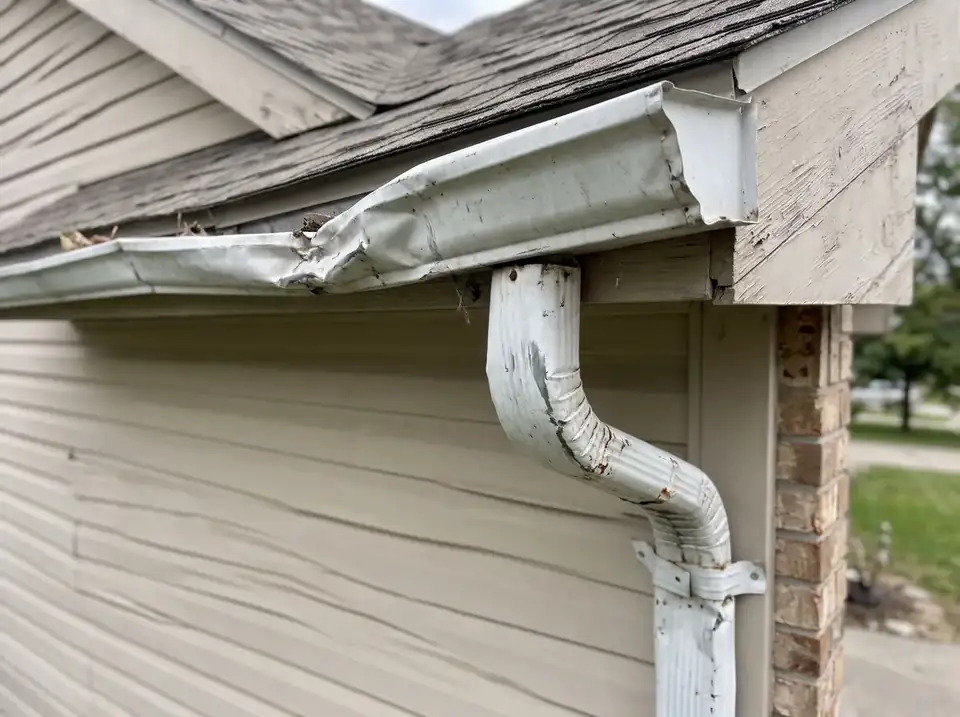
A limb or a gust has creased or torn down a length
Shallow dents can stay. A crease, a torn seam or a flattened downspout changes how water drains and means a new section. The storm damage page covers what to photograph for an insurer.
Puddles at the slab, the patio or a crawl-space vent
A downspout is letting go too close to the wall, or a buried line has silted up. A longer extension, a moved downspout or a flushed line usually ends it. See downspout repair.
Fine all summer, then overflowing in the first November storm
Months of dry leaves and seed balls turn to sludge in the first real rain and block the outlet. Clean before the rains. If it happens every year, a wide-mouth outlet on a 3x4 downspout, or fine mesh over the gutter, stops it. See street trees and gutters.
Water lands behind the gutter on a tile roof
The gutter sits too low or too far back for the throw from the tile lip. It needs re-hanging closer under the tile. See gutters on tile roofs.
How does a repair visit run?
- The gutter is emptied, because faults hide under leaves
- A hose is run to see where water goes and where it stops
- A level is laid along each run to check the fall
- Hangers are tested and the fascia probed
- The cause is fixed: a reseal, a re-hang, a new length, an added outlet or new wood
- Water is run again to prove it
Why do gutters fail here in particular?
Summer sun. With roughly 79 afternoons a year at 90 degrees or hotter, sealant hardens and paint chalks. A corner sealed ten years ago is often the first drip of the season.
A long wait. A gutter that is dry all summer shows nothing until the first real storm. Then every crack, loose spike and blocked outlet appears in the same afternoon.
Wet weight. Leaves that fell in October become heavy sludge once soaked, and pull at the fixings all winter.
Damp wood in winter. Tule fog can sit over the valley for days at a time between November and March. Fascia behind a full gutter stays wet and slowly rots.
Stucco. Straps fixed into stucco without proper anchors work loose and crack the finish around them.
Repair, or replace?
| What is found | Sensible response |
|---|---|
| A couple of weeping corners on straight metal | Reseal them |
| A run pulled loose, wood still firm | Re-hang on hidden hangers |
| One dented length | Replace that length |
| Fascia soft along a wall | New board, and usually new gutter on that wall |
| Old sectional gutter dripping at most joints | Replace with seamless |
| Paint chalked through to bare metal all round | Replace |
The guide to repair or replace goes deeper.
What do repairs cost?
There is no published local price list. Cost tracks time on site and wall height, and most Modesto houses are a single storey, which helps.
| Job | Relative cost |
|---|---|
| Resealing a corner | Low |
| Clearing a blocked downspout | Low |
| Re-hanging a run | Low to medium |
| Adding a downspout | Low to medium |
| Replacing a section | Medium |
| Fascia replacement and re-hang | Medium to high |
| Second-storey work or work over tile | Higher, for access and care |
Ask for each item to be priced on its own line.
Is a licensed contractor needed for repairs?
California requires a license for jobs of $1,000 or more. Under that, the minor work exemption only applies when no permit is needed and the worker hires no help. Single repairs usually come in under the line, but a visit that bundles several can pass it.
Which repairs can I handle myself?
On a single storey, with a ladder standoff and someone to steady it: clearing a downspout, resealing a low corner on a dry day, swapping a spike for a hidden hanger. Do not walk on tile. Leave second-storey walls and anything near a power line to a contractor.
What can I check before calling?
From the ground on a dry day, look along each run for dips, look at corners for stains on the stucco, look at the fascia for peeling paint, and check every downspout ends on its extension. In the first storm, take a short video of any spill. It saves time on the call.
Which repairs should not wait?
- A run hanging by one end
- Water pouring down stucco or into a window
- Water marks on an eave or ceiling
- A downspout emptying against the slab
- Blocked outlets with the first storm of the season forecast
Parts a repair can involve
| Term | Plain meaning |
|---|---|
| Hidden hanger | A bracket clipped inside the gutter, held by a long screw through the gutter back into the fascia |
| Spike and ferrule | A long nail through the front of the gutter with a sleeve around it. The usual fixing on older gutters, and the one that loosens |
| Fascia | The trim board nailed across the rafter ends. On most Modesto houses the gutter screws into it |
| Soffit | The underside of the eave, from the fascia back to the stucco or siding |
| Drip edge | Bent metal flashing laid under the first course of roofing. It throws water forward into the gutter |
| Gutter apron | A wider flashing shaped like an L. It slides under the roofing and drops into the gutter, sealing the gap behind it |
| Strip miter | A corner made from two 45-degree cuts, joined under a strip of metal |
| End cap | The flat piece that stops off the end of a run |
| Outlet | The tube set into the gutter floor that feeds the downspout. Also called a drop |
| Elbow | A bent length of downspout. A-style bends in and out from the wall, B-style bends sideways |
| Strap | A band screwed to the wall that holds a downspout |
| Sealant | The rubbery compound inside each joint. Sun and heat wear it out first |
| Stucco | The cement plaster finish on most valley houses. Downspout straps fix into it with masonry anchors |