
On this page
- How many downspouts does a house need?
- Which downspout size?
- How is a downspout put up?
- What are A and B elbows?
- Where should the water go?
- Are rain barrels worth it in a dry climate?
- How is a buried drain line put in?
- What goes wrong most often?
- What does adding or moving one cost?
- Are there rules about where water goes?
- Should downspouts match the stucco?
- Downspout and drainage terms
How many downspouts does a house need?
Plan on one for every 30 to 40 feet of gutter, plus one close to each roof valley. Long ranch walls with a single outlet back up at the far end in a heavy winter storm. Adding an outlet and downspout is one of the cheapest fixes there is.
Which downspout size?
| Downspout | Usually paired with | Notes |
|---|---|---|
| 2x3 inch | 5-inch gutter | About 600 sq ft of roof as a rule of thumb. Jams under big leaves |
| 3x4 inch | 6-inch gutter, or any gutter under trees | About twice the flow. Swallows sycamore leaves |
| 3 or 4-inch round | Half-round gutter | Period houses |
How is a downspout put up?
- An outlet position is picked where water can be carried away from the slab
- The outlet hole is cut and the drop sealed in
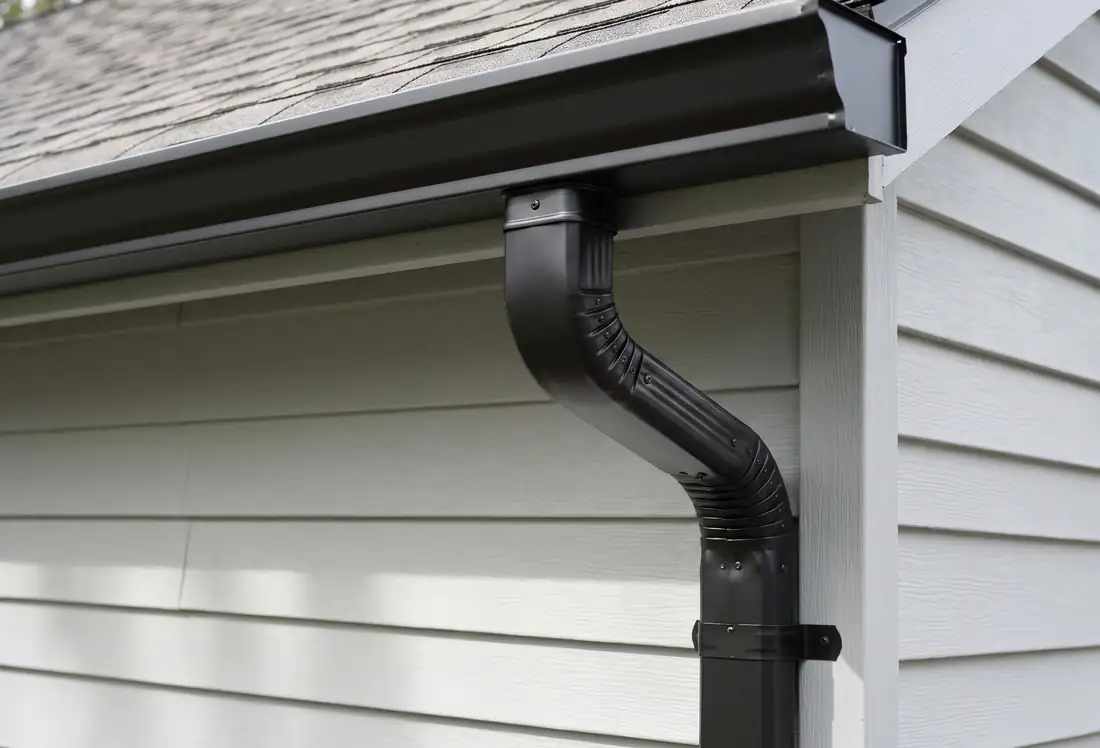
- Two elbows take the pipe from the outlet back to the wall
- Pipe is cut so every upper piece fits inside the piece below it
- Straps go in at the top, the bottom and every six to eight feet, on masonry anchors in stucco
- A bottom elbow turns the water toward an extension, splash block, barrel or drain line
What are A and B elbows?
An A-style elbow bends toward or away from the wall. It brings the pipe back from the outlet and turns water out at the bottom. A B-style elbow bends sideways along the wall, which helps get round a window or door. Most downspouts use two A elbows up top and one at the foot.
Where should the water go?
Away from the house, onto ground that falls away, somewhere it can soak in. Modesto lies on level valley floor at about 89 feet, and much of the soil round it is clay or silty loam that takes water slowly. A downspout that stops at the slab leaves a pool that can sit for days after a winter storm.
| Discharge | Suits | Watch for |
|---|---|---|
| Splash block | Ground already sloping away | Little help on a flat lot |
| Rigid extension, 4 to 6 feet or more | Most walls | Moved for mowing and left off |
| Hinged extension | Beside paths and lawns | Must be flipped back down |
| Buried solid pipe to a pop-up emitter | Level yards, paths in the way | Needs steady fall and a cleanout |
| Pipe into a bed or rain garden | Larger yards | Keep it well clear of the slab |
| Rain barrel | Spring watering | The overflow still needs a route away |
| Drywell | Lots with nowhere to drain | Must suit the soil. Ask the city first |
Are rain barrels worth it in a dry climate?
They can be. Almost all the rain arrives between November and March, and a barrel stores some for spring planting. A roof sheds roughly 0.6 gallons per square foot for each inch of rain, so 1,000 square feet of roof fills a 50-gallon barrel in about a tenth of an inch. Barrels fill fast and overflow often. Fit a diverter or an overflow that rejoins the downspout route, keep the lid tight against mosquitoes, and never let the overflow spill at the slab.
How is a buried drain line put in?
- Call 811 so buried utilities are marked
- Dig a trench that keeps falling all the way to the outlet
- Lay smooth-wall solid pipe. Thin corrugated pipe silts up and crushes
- Connect the downspout through a cleanout fitting
- Finish at a pop-up emitter in the lawn or inside a planted bed
- Mind the sprinkler lines, test with a hose and backfill
What goes wrong most often?
- Downspouts that end on a patio, at the slab or by a crawl-space vent
- Extensions taken off for mowing and never replaced
- Buried lines silted up after a few dry years
- Sprinkler lines cut during trenching
- Straps working loose from cracked stucco
- Water aimed at a driveway that falls toward the garage
See downspout repair.
What does adding or moving one cost?
There is no published local price list. Adding a downspout is a small job: an outlet, elbows, pipe, straps and an extension. Moving one adds patching the old outlet. Buried lines are priced per foot.
Are there rules about where water goes?
Keep roof water on your own lot until it reaches a proper outlet. Connecting to a storm drain or the curb can be regulated. Ask the City of Modesto, your own city or Stanislaus County before you do.
Should downspouts match the stucco?
Many owners pick a downspout color close to the wall so it disappears, and a gutter color that matches the fascia. Coil and downspouts come in matching shades.
Downspout and drainage terms
| Term | Plain meaning |
|---|---|
| Downspout | The pipe that carries water from gutter to ground. Also called a leader, the word California license rules use |
| Outlet | The tube set into the gutter floor that feeds the downspout. Also called a drop |
| Elbow | A bent length of downspout. A-style bends in and out from the wall, B-style bends sideways |
| Strap | A band screwed to the wall that holds a downspout |
| Splash block | A sloped pad under a downspout that spreads the water |
| Extension | A length added at the foot of a downspout to carry water farther out |
| Cleanout | A capped fitting where a downspout enters a buried pipe, so the pipe can be flushed |
| Pop-up emitter | A lidded outlet set level with the lawn at the end of a buried pipe |
| Stucco | The cement plaster finish on most valley houses. Downspout straps fix into it with masonry anchors |
See also downspout drainage and your foundation.