
On this page
- What makes a gutter seamless?
- Why does one piece per wall matter in Modesto?
- How does a seamless install go, start to finish?
- Which corner type should I ask for?
- What widths, metals and colors are available?
- How much do seamless gutters cost?
- Are there limits to seamless?
- How do I check a finished seamless job?
- Which houses here gain the most?
- What should I ask before booking?
- Words you will see on a seamless quote
What makes a gutter seamless?
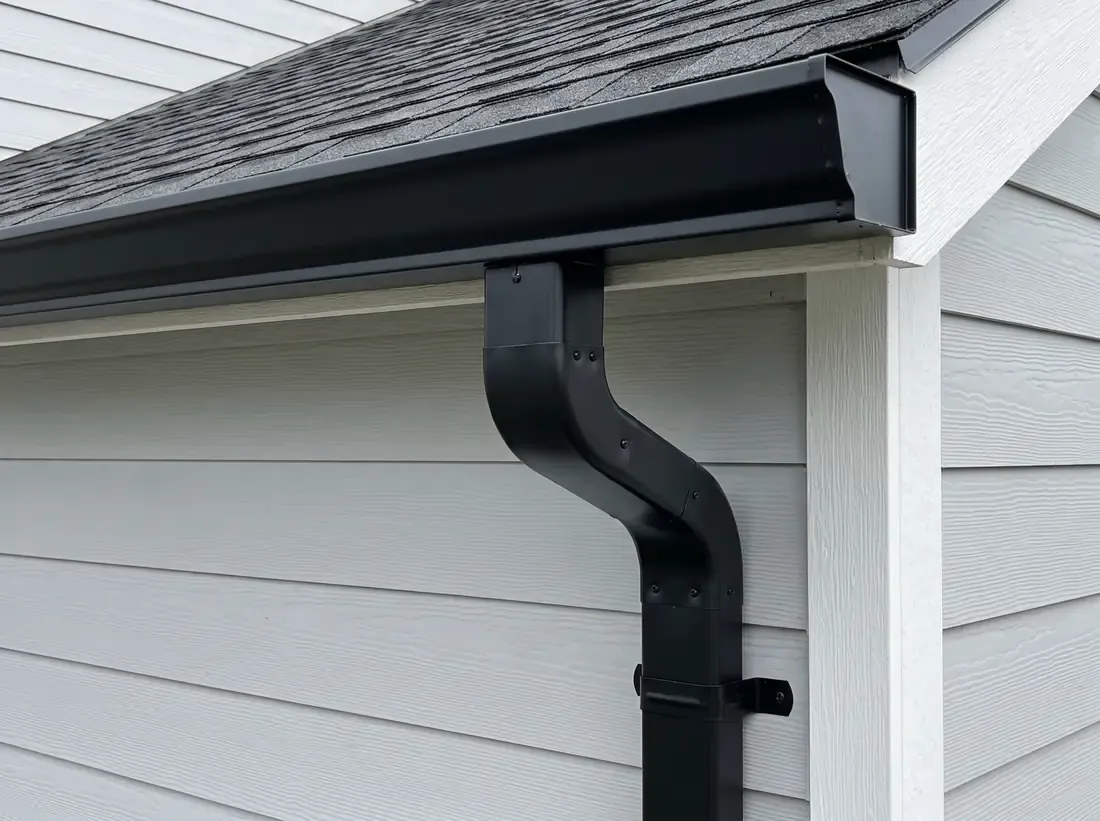
The crew brings a roll-former on a trailer. Painted aluminum coil feeds into it flat, a series of rollers bends it into the K-style profile, and the finished gutter slides out the far end for as long as the crew lets it run. Measure a wall at 48 feet and you get one 48-foot piece. Sectional gutter, by contrast, arrives in ten-foot sticks that are joined on the house.
Why does one piece per wall matter in Modesto?
Because the weak spot in any gutter is a sealed joint, and the valley is hard on sealant. Modesto sees 79 or so afternoons a year at 90 degrees and up. A south-facing gutter in July sits well above air temperature, and aluminum grows a little every afternoon and shrinks again overnight. Each cycle tugs at the bead of sealant in every joint. Over a few summers the bead cracks, and the first November storm finds the gap. A 48-foot wall in sectional gutter carries four of those joints along its length. In seamless it carries none.
How does a seamless install go, start to finish?
- Old gutters, spikes and straps come off and the fascia gets a screwdriver test
- Each eave is measured and outlet spots marked where water can be carried off the slab
- A chalk line is snapped along the fascia, falling toward each outlet
- The machine runs out each length, which is cut a touch long and trimmed to fit
- Outlet holes are punched and end caps crimped and sealed while the gutter lies on sawhorses
- Two or three people walk the length up ladders and screw it on through hidden hangers
- Corners are cut, joined with rivets and sealed from inside
- Downspouts go up, strapped into the stucco on masonry anchors
- A hose run at the high end of every run checks fall and joints
Which corner type should I ask for?
| Corner | What it is | Joints to seal | Verdict |
|---|---|---|---|
| Hand-cut miter | The gutter end is cut and folded on site to meet its neighbor | One | Tidiest, smooth inside |
| Strip miter | Two 45-degree cuts covered by a metal strip | One | Quick and common |
| Box miter | A pre-made corner both runs slide into | Two | Twice the sealant exposed to sun |
What widths, metals and colors are available?
| Option | Notes for a Modesto house |
|---|---|
| 5-inch K-style | Right for most single-storey ranches |
| 6-inch K-style | For valleys, steep planes and metal roofs |
| Aluminum, 0.027 or 0.032 inch | The default. Thicker under trees |
| Steel or copper | Possible with the right machine, less common |
| Tan, almond, sandstone, clay | Blend into most stucco |
| Bronze or dark brown | Suit terracotta tile and dark trim |
| White | Crisp on pale stucco, shows dust |
How much do seamless gutters cost?
Price guides from Angi and This Old House list fitted seamless aluminum between roughly $9 and $14 per foot for 5-inch and $11 to $17 for 6-inch. Treat those as national markers, not Modesto quotes. A plain single-storey ranch usually lands toward the lower end. Tile roofs, two-storey walls and fascia repair push it up. The Modesto cost guide works through whole-house sums, and seamless vs sectional compares the two systems.
Are there limits to seamless?
Three worth knowing. Very long runs, roughly 40 feet and up, need to drain both ways from a high point or carry an expansion joint, since a single length moves more in heat. The truck needs a straight stretch of driveway or street about as long as the longest wall. And half-round profiles need a different machine that fewer contractors run.
How do I check a finished seamless job?
- Look along each wall: no seams between corners
- Look underneath: hangers every two feet or closer
- Stand back: the gutter should visibly fall toward each downspout
- At corners, sealant should be inside and neat, with no gaps
- Each downspout should end on an extension, splash block or drain line
- Run a hose: water should reach the downspout with nothing pooling
Which houses here gain the most?
| House | Why seamless pays |
|---|---|
| Long stucco ranch | Walls of 50 feet or more would carry four or five joints in sectional |
| House under a street tree | Nothing inside the gutter for leaves to hang on |
| Tile roof | Fewer future visits to a roof edge crews must treat gently |
| Two-storey home | Upper runs are expensive to revisit for leaks |
What should I ask before booking?
- Is the gutter formed at my house, in both 5 and 6-inch?
- What thickness of coil do you use?
- Hand-cut, strip or box corners?
- Where will each downspout empty?
- How will you handle runs over 40 feet?
- What is your California license number?
Words you will see on a seamless quote
| Term | Plain meaning |
|---|---|
| Coil | Flat painted metal on a roll, fed through the machine that makes seamless gutter |
| K-style | The common gutter shape: flat back, curved front. Also called ogee |
| Hidden hanger | A bracket clipped inside the gutter, held by a long screw through the gutter back into the fascia |
| Hand-cut miter | A corner folded and cut from the gutter on site, then riveted and sealed |
| Box miter | A factory-made corner that both gutter ends slot into. Two joints in place of one |
| End cap | The flat piece that stops off the end of a run |
| Outlet | The tube set into the gutter floor that feeds the downspout. Also called a drop |
| Fall | The gentle slope along a gutter toward its outlet, about a quarter inch in ten feet |
| Expansion joint | A flexible join that lets a long run grow in summer heat and shrink in winter |