
On this page
- Where does copper make sense around Modesto?
- What do copper gutters cost?
- Which weight of copper?
- How is a copper system installed?
- How does copper weather in a dry valley?
- Why do expansion joints matter so much here?
- What has to be planned around copper?
- Does copper suit a tile roof?
- How long does copper last?
- What should a copper quote spell out?
- Copper gutter terms
- Is copper theft a worry?
- Can copper be added to an existing aluminum system?
Where does copper make sense around Modesto?
On period houses near downtown and Graceada Park, on Spanish revival homes with clay barrel tile, on Craftsman bungalows with deep eaves, and on custom homes where the gutter is part of the design. Many owners use copper only where it shows, over the front porch, a bay window or the entry, and color-matched aluminum round the back.
What do copper gutters cost?
National price guides put fitted copper at roughly $29 to $40 a foot, around three times aluminum. On a house needing 160 feet that works out to about $4,640 to $6,400, against $1,440 to $2,720 in aluminum by the same guides. That is arithmetic from national ranges, not a quote. Copper prices follow the metals market, so a copper quote may hold for only a few weeks.
| Painted aluminum | Copper | |
|---|---|---|
| Fitted price, national guides | $9 to $17 a foot | $29 to $40 a foot |
| Typical life | Twenty years or more | Several times that |
| Seams | Sealed | Soldered |
| Look over time | Holds its painted color | Bright, then brown, slowly greener |
| Upkeep | Reseal joints in time | Little beyond cleaning |
Which weight of copper?
Copper sheet is sold in ounces per square foot. 16-ounce is the usual weight for house gutters. 20-ounce is stiffer and is used for wide profiles, long unsupported spans and linings for built-in gutters.
How is a copper system installed?
- A string line sets the fall, and brackets are fixed to fascia or rafter tails
- Copper lengths are dropped into the brackets and overlapped at the joins
- Each lap, end cap and outlet is cleaned, fluxed and soldered
- Expansion joints are built into long runs, since soldered seams cannot stretch
- Round downspouts hang from copper or brass straps
- A collector head goes where two gutters feed one downspout
Copper takes longer than aluminum because seams are soldered by hand. A house that takes a day in aluminum may take two or three in copper.
How does copper weather in a dry valley?
Slowly. New copper turns brown within months. The blue-green layer that forms quickly in wet, salty coastal air takes much longer inland, and some copper here stays brown for decades. Whatever the color, the surface layer protects the metal underneath. No sealer or polish is needed.
Why do expansion joints matter so much here?
Copper grows in heat like any metal. With 79 or so afternoons a year at 90 degrees and up, a long soldered run with no way to move can split its seams. A good quote shows where the expansion joints go.
What has to be planned around copper?
| Issue | How to handle it |
|---|---|
| Mixing metals | Copper or brass fixings only. Keep aluminum flashing out of contact |
| Staining | Run every outlet into a downspout and discharge onto gravel or a drain, away from pale stucco |
| Historic listings | Ask the city before changing a street-facing roof edge on a listed property |
| Theft | Use tamper-resistant fasteners on ground-level downspouts, or keep copper to the upper runs |
Does copper suit a tile roof?
Copper half-round under clay barrel tile is a traditional match on Spanish revival houses. The gutter still has to sit under the tile lip so water drops in. Keep copper runoff to the downspouts, so it does not tint the stucco.
How long does copper last?
Many decades. It does not rust. Systems are usually replaced after physical damage or failed solder, not wear.
What should a copper quote spell out?
- Weight of sheet, 16 or 20-ounce
- Profile and size
- That seams are soldered
- Bracket style, metal and spacing
- Where each expansion joint goes
- Downspout size and strap metal
- How long the price is held
- The contractor's license number
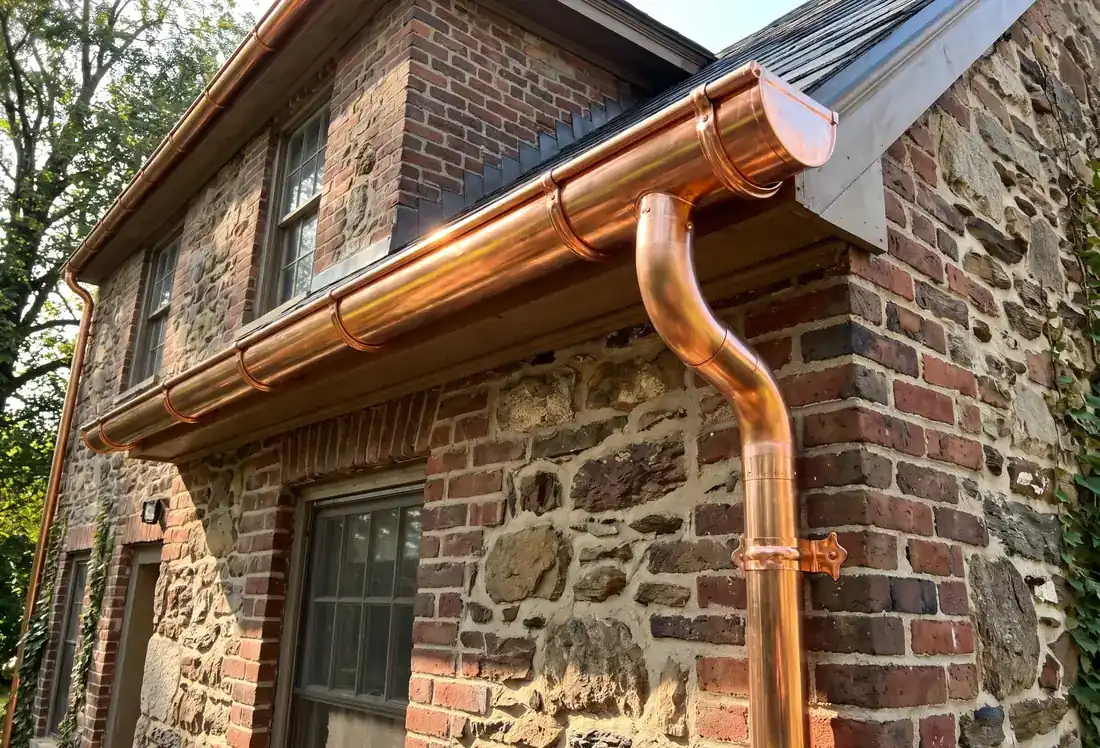
Copper is most often made in half-round.
Copper gutter terms
| Term | Plain meaning |
|---|---|
| Gauge | Metal thickness. House gutter is 0.027 or 0.032 inch aluminum. Copper comes in 16 or 20 ounce |
| Half-round | A gutter shaped like half a tube. It was usual before about 1940 |
| Bracket | A cradle fixed under the gutter to hold it up. Standard with half-round |
| Collector head | An open box at the top of a downspout that catches water from a scupper or from two gutters |
| Outlet | The tube set into the gutter floor that feeds the downspout. Also called a drop |
| Downspout | The pipe that carries water from gutter to ground. Also called a leader, the word California license rules use |
| Expansion joint | A flexible join that lets a long run grow in summer heat and shrink in winter |
Is copper theft a worry?
Copper has scrap value, and the bottom few feet of a downspout are the easiest part to take. Tamper-resistant screws at ground level, a painted aluminum downspout on a hidden wall, or keeping copper to the upper runs all reduce the risk. Some owners photograph the system after installation for their insurance records.
Can copper be added to an existing aluminum system?
Yes, on a separate run, such as the front porch, provided the two metals never touch and copper runoff does not drain onto aluminum below. The join between them is usually made at a downspout or a corner with a non-metal separator.