
On this page
- Which systems suit which buildings?
- How is a commercial system put in?
- Why does heat matter so much on big roofs?
- How are sizes worked out?
- How do flat roofs drain?
- Where does the water end up?
- What goes wrong on commercial roofs?
- What is different about older downtown buildings?
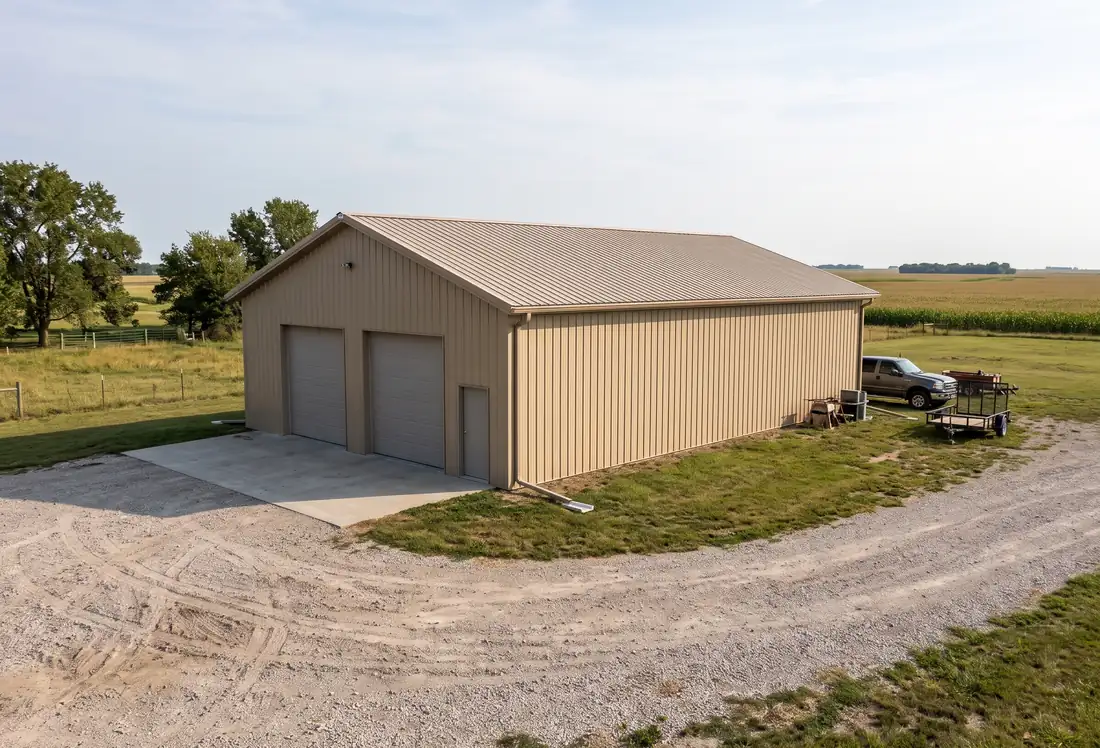
- How are metal buildings handled?
- What about packing sheds and farm buildings?
- What should a commercial quote contain?
- Is a license required for commercial work?
- How often should commercial gutters be cleaned?
- What records help a property manager?
- How do multi-unit communities organize the work?
- When is replacement better than repair?
- Commercial gutter terms
Which systems suit which buildings?
| Building | Common setup |
|---|---|
| Metal warehouse, packing shed or shop | Coated steel box gutter in the panel color, 4x5 or larger leaders |
| Strip center or office | 6 or 7-inch K-style or box gutter, sometimes hidden behind a parapet |
| Flat roof with parapet walls | Scuppers into collector heads and leaders |
| Church or school | Large K-style or half-round. Copper on some older buildings |
| Apartments and townhouses | 6-inch seamless aluminum on long shared eaves |
| Older downtown brick building | Built-in or box gutter, often relined |
| Barn or equipment shed | 6-inch K-style or box gutter over doors and along the busy side |
How is a commercial system put in?
- Roof area, pitch and drain points are surveyed
- Gutter and leader sizes are calculated from roof area and design rainfall
- Brackets go in to a string line at the spacing the gutter size calls for
- Sections are lifted, lapped, fastened and sealed
- Expansion joints are placed on long runs
- Leaders are strapped down and tied in at grade
- The system is flooded and inspected
Why does heat matter so much on big roofs?
A steel eave on a metal building can run well past a hundred feet. With roughly 79 afternoons a year at 90 degrees or hotter, that steel grows and shrinks a lot every day. Without expansion joints, laps pull apart and leak in the first storm. A commercial gutter here has to be designed for movement as much as for water.
How are sizes worked out?
By calculation, not habit. The annual rain total is low, but winter storms can drop a lot in a short time, and outlets are almost always the bottleneck.
| Roof | Gutter | Leader |
|---|---|---|
| Small shop or office | 6-inch K-style | 3x4 |
| Church hall or school wing | 6 or 7-inch K-style | 3x4 or 4x5 |
| Warehouse or packing shed | 7 or 8-inch box | 4x5 and larger |
| Flat roof | Scuppers and collector heads | 4x5 or round |
How do flat roofs drain?
Through scuppers in the parapet into collector heads, or through internal drains. Dust and leaves pile up at those outlets all summer. Clear them before the rains, or water ponds on the roof in the first storm.
Where does the water end up?
Usually in a storm drain or the site's own drainage. Changing how stormwater leaves a commercial site can require approval, so ask the City of Modesto, your own city or Stanislaus County before altering it.
What goes wrong on commercial roofs?
| Problem | Typical cause |
|---|---|
| Ponding on a flat roof | A scupper or drain blocked after the dry season |
| Leaking laps | No expansion joint, or sealant baked by heat |
| Gutter pulling off a metal building | Brackets spaced too far apart |
| Leaders crushed at the base | Forklifts and trucks. Fit guards |
| Streaks down a wall | An undersized outlet |
What is different about older downtown buildings?
Brick buildings downtown and in older town centers often have parapets, built-in gutters and internal drains. The linings age and water gets into the masonry. Repair usually means relining in metal or membrane and clearing or renewing drains. On buildings with historic status, changes visible from the street may need city review.
How are metal buildings handled?
- Eave height and panel profile are recorded
- Box gutter is formed or ordered in matching coated steel
- Brackets fix to the eave strut at the spacing the size needs
- Sections are lapped and sealed, with end caps, outlets and expansion joints
- Large leaders are strapped to the wall panels and run to grade
What about packing sheds and farm buildings?
Many sheds, barns and processing buildings across the county have long metal roofs. Gutters keep water away from doors where forklifts and trucks work and off the base of the walls. Leaders near loading areas need guards at the bottom. Dust and chaff from harvest pack into outlets, so a clean before the rains matters.
What should a commercial quote contain?
- The contractor's California license number and classification
- Gutter and leader sizes, with the roof area behind each
- Metal, gauge and finish
- Bracket spacing and expansion joint locations
- How leaders connect at grade
- Access method and expected disruption
- A certificate of liability insurance
- A suggested maintenance schedule
Is a license required for commercial work?
Yes. California's license requirement applies to any job of $1,000 or more, and gutters and leaders come under the C-43 Sheet Metal classification. Property managers should also ask for proof of insurance.
How often should commercial gutters be cleaned?
At least once a year before the rains, twice under trees, and check the scuppers after any big storm.
What records help a property manager?
Dates of each cleaning, photos of every scupper and drain, and notes on repairs. They help pin down a leak and are useful when the building is sold or insured.
How do multi-unit communities organize the work?
| Step | Who |
|---|---|
| Agree the scope: cleaning, repair or replacement | Board or manager |
| Site visit and condition report | Contractor |
| Written quote per building | Contractor |
| Notice to residents | Manager |
| Work, one building at a time | Contractor |
| Sign-off with photos | Manager |
The lease or association documents decide who pays for what on shared property.
When is replacement better than repair?
When laps leak along the whole run, when the gutter was undersized from the start, or when brackets have torn from the structure. Patching those costs more over a few years than a correctly sized new system.
Commercial gutter terms
| Term | Plain meaning |
|---|---|
| Box gutter | A deep, square gutter in steel for big commercial roofs |
| Scupper | A hole through a parapet that lets water off a flat roof |
| Collector head | An open box at the top of a downspout that catches water from a scupper or from two gutters |
| Downspout | The pipe that carries water from gutter to ground. Also called a leader, the word California license rules use |
| Expansion joint | A flexible join that lets a long run grow in summer heat and shrink in winter |
| Outlet | The tube set into the gutter floor that feeds the downspout. Also called a drop |
| Gauge | Metal thickness. House gutter is 0.027 or 0.032 inch aluminum. Copper comes in 16 or 20 ounce |
| Strap | A band screwed to the wall that holds a downspout |
| Cleanout | A capped fitting where a downspout enters a buried pipe, so the pipe can be flushed |