
On this page
- What goes wrong with downspouts?
- How do you clear a blocked downspout?
- Why does mine keep clogging?
- How should a downspout be assembled?
- How is a downspout refixed to stucco?
- Why do tall downspouts fail?
- How are buried drain lines repaired?
- When should a downspout be moved?
- When does a downspout need replacing?
- How can I protect the bottom section?
- What do downspout repairs cost?
- What should I tell the contractor?
- Downspout parts
- Can I clear a downspout myself?
What goes wrong with downspouts?
| Problem | Usual cause | Fix |
|---|---|---|
| Gutter spills above the downspout | A plug at the outlet or first elbow | Clear and flush. Fit a wider outlet if it recurs |
| Water spraying from a joint | Pieces fitted upside down or pulled apart | Re-assemble so each upper piece sits inside the lower |
| Pipe hanging off the wall | Anchors pulled out of the stucco | New straps on masonry anchors |
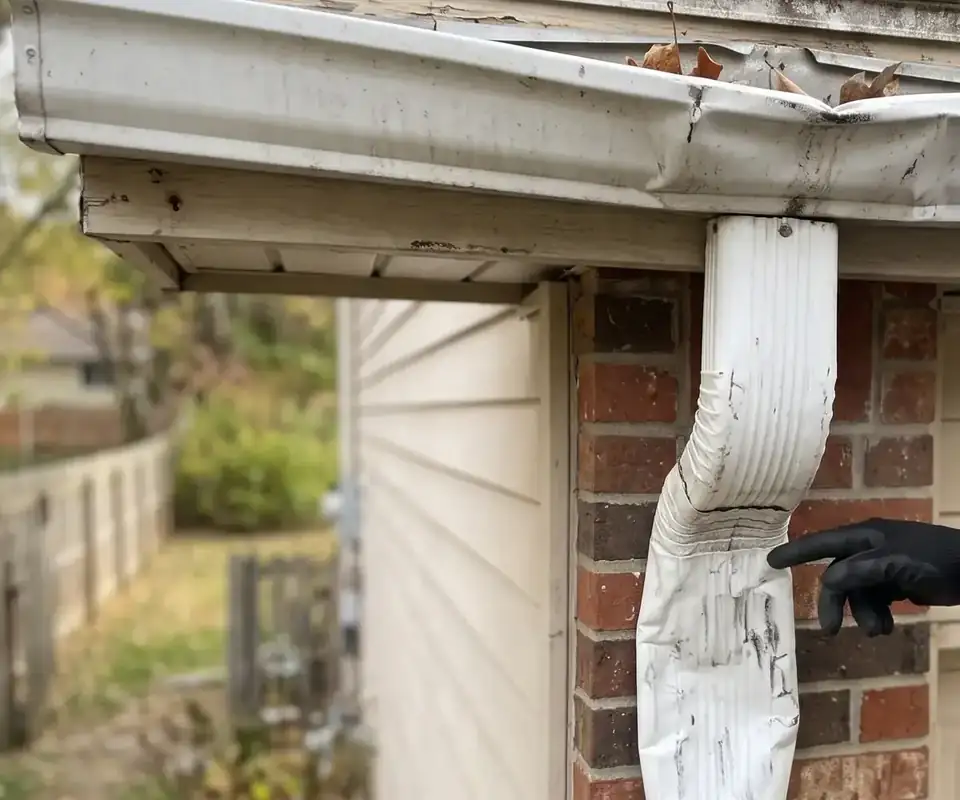
| Flattened at the bottom | A mower, bin or car | New bottom section and elbow |
| A pool at the base | No extension, or a blocked buried line | Add an extension or clear the line |
How do you clear a blocked downspout?
- Look into the outlet from the gutter and pull out whatever is bridging it
- Run a hose down from the top
- If it backs up, tap along the pipe to find the plug by sound
- Pull the bottom elbow and clear it
- For a plug mid-pipe, unstrap the downspout and push it through
- Put it back together, screw each joint and test
Why does mine keep clogging?
The outlet is too small for what falls on the roof. A single sycamore or plane leaf can cover a 2x3 outlet. Sweetgum balls and pistache berries jam it. The lasting answer is a wide-mouth outlet and a 3x4 downspout, or a guard over the gutter.
How should a downspout be assembled?
- Every upper piece slides inside the one below it, so water cannot escape at the joint
- Each joint gets two screws or rivets
- Elbows at the top bring the pipe back to the wall
- Straps hold it at the top, the bottom and in between
- A bottom elbow turns water away from the house
- An extension or drain line finishes it off
Downspouts put together upside down leak at every joint.
How is a downspout refixed to stucco?
Old straps come off and the holes are sealed. New straps go in on masonry anchors sized for stucco. Screws driven straight into stucco without anchors crack it and pull out. On a two-storey wall, use a strap every six to eight feet.
Why do tall downspouts fail?
A long downspout has more joints and more strap points, and wind works it loose. A blockage near the top is out of reach. Use 3x4 pipe, straps every six to eight feet and two screws at every joint.
How are buried drain lines repaired?
| Problem | Repair |
|---|---|
| Silt after dry years | Flush from the cleanout |
| Roots | Snake it, and replace that length if roots come back |
| Crushed pipe | Dig it up and relay in solid pipe |
| Lost emitter | Find it, clear it and reset it |
| No fall | Relay it to a steady slope |
Water welling up at the foot of the downspout, or a soggy stripe of lawn along its route, means the line has failed. Watch for sprinkler lines when digging.
When should a downspout be moved?
When it empties onto a path, a patio that falls toward the house, a doorstep or a crawl-space vent, or anywhere water cannot be led away. Moving it means a new outlet and a patched hole.
When does a downspout need replacing?
When it is crushed, split, dented in several places or too small. A new length with elbows costs little, and it is the moment to go up to 3x4 and add a cleanout.
How can I protect the bottom section?
A heavier bottom piece, a hinged extension that flips up, or taking the water underground. Keep bins and mowers clear of it.
What do downspout repairs cost?
| Job | Relative cost |
|---|---|
| Clearing a blockage | Low |
| Refitting loose straps | Low |
| New bottom section and elbow | Low |
| Wide-mouth outlet | Low |
| Upsizing to 3x4 | Low to medium |
| Buried line repair | Medium, per foot |
What should I tell the contractor?
Which downspout, what happens in rain, whether it goes underground, and whether the wall is stucco, siding or brick. Afterward, check where the water ends up. See downspouts and drainage.
Downspout parts
| Term | Plain meaning |
|---|---|
| Downspout | The pipe that carries water from gutter to ground. Also called a leader, the word California license rules use |
| Outlet | The tube set into the gutter floor that feeds the downspout. Also called a drop |
| Elbow | A bent length of downspout. A-style bends in and out from the wall, B-style bends sideways |
| Strap | A band screwed to the wall that holds a downspout |
| Cleanout | A capped fitting where a downspout enters a buried pipe, so the pipe can be flushed |
| Pop-up emitter | A lidded outlet set level with the lawn at the end of a buried pipe |
| Splash block | A sloped pad under a downspout that spreads the water |
| Extension | A length added at the foot of a downspout to carry water farther out |
| Stucco | The cement plaster finish on most valley houses. Downspout straps fix into it with masonry anchors |
Can I clear a downspout myself?
On a single storey, usually. Pull debris from the top of the outlet by hand, run a hose down, and take off the bottom elbow if water backs up. Leave tall downspouts, buried lines that need digging, and anything near a power line to a contractor.