
On this page
- What kinds are there?
- How does each perform here?
- Are screens worth it?
- Is a perforated cover the best value?
- Do reverse-curve hoods work?
- Why avoid foam and brush inserts?
- How are these guards fitted?
- What does pitch mean?
- Which guard suits which lot?
- What do they cost?
- How long do they last?
- What warning signs should I watch for?
- Can a cheap guard make cleaning harder?
- What should I ask?
- Guard types and parts
- Do any of these suit a metal-roofed shop?
What kinds are there?
| Type | Description | Fixing |
|---|---|---|
| Expanded-metal or plastic screen | Sheet with diamond-shaped openings | Drops in, or clips under the lip |
| Hinged screen | A screen that lifts for access | Clips to the lip |
| Perforated aluminum cover | Solid sheet punched with small holes | Screws to the lip and fascia |
| Reverse-curve hood | Solid cover with a rounded nose | Fixes to fascia or roof edge, often under roofing |
| Foam or brush insert | Filler pushed inside the gutter | Pushed in |
How does each perform here?
| Type | Seeds and berries | Big leaves | Valley heat | Price |
|---|---|---|---|---|
| Expanded screen | Poor | Fair | Metal fine, plastic warps | Low |
| Perforated cover | Good | Good | Good | Medium |
| Reverse curve | Fair | Good | Good | High |
| Micro-mesh | Good | Good | Good | High |
| Foam or brush | Poor | Poor | Breaks down | Low |
Are screens worth it?
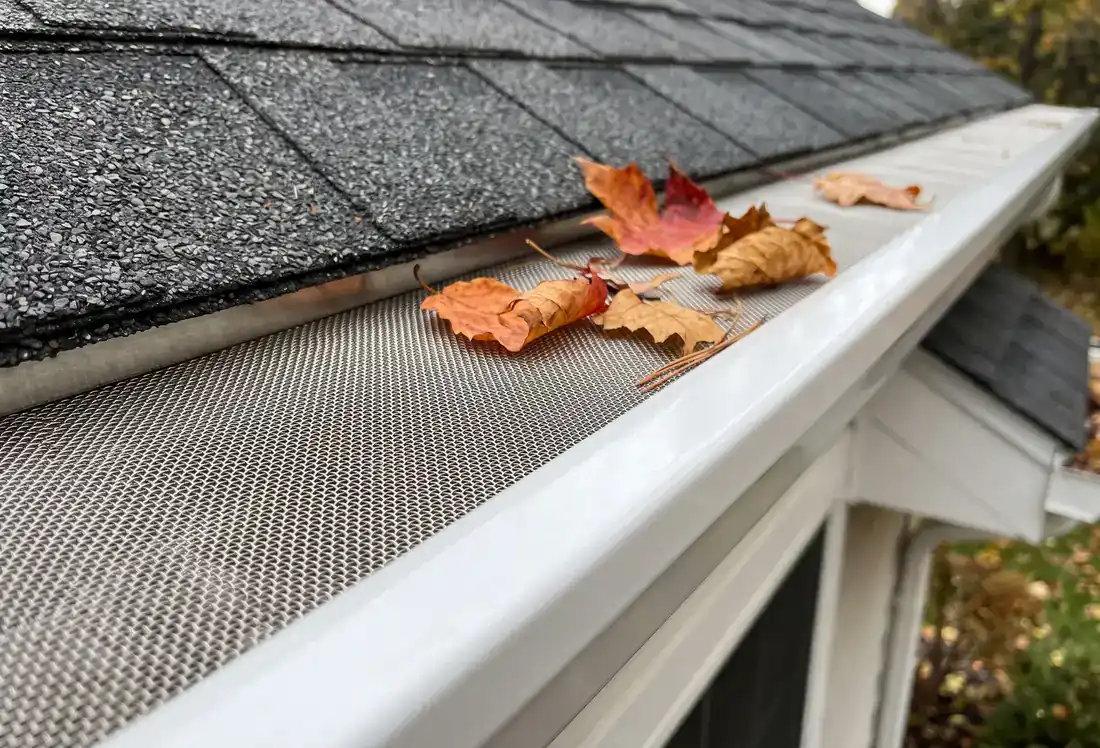
A screen keeps out whole leaves and twigs. Elm seeds, ash keys and pistache berries go through or wedge in the holes. Plastic screens warp and crack after a few valley summers. A metal screen suits a house with a few large-leaved trees and an owner happy to clean every year or two.
Is a perforated cover the best value?
For many valley lots under big-leaved trees, yes. It is stiff and neat, its small holes handle most seeds, and it fixes to the gutter and fascia without touching tile. Under sycamore, plane and ash, it is fair value. Under elm and pistache, fine mesh is worth the extra.
Do reverse-curve hoods work?
With big leaves and steady rain, yes. Their drawbacks here:
- In a downpour water can leave the nose and miss the slot
- Small seeds follow the water inside
- Wasps nest in the sheltered space
- Many tuck under the first row of roofing, which on tile means lifting tiles
- The hood is visible from the street
Why avoid foam and brush inserts?
They catch debris inside the gutter and keep it there. Through a dry summer that is a strip of tinder at the roof edge. Through winter it is a wet sponge against the fascia.
How are these guards fitted?
- The gutter is cleaned and flushed
- Fall and hangers are checked and fixed
- The guard is cut and fixed in place
- Ends and corners are closed
- Valleys get a diverter
What does pitch mean?
The angle of the guard. One set level holds leaves on top. One set at a slight forward angle, following the roof, lets debris slide off as it dries. Too steep, and water can skim over in a downpour.
Which guard suits which lot?
| Lot | Sensible choice |
|---|---|
| Ranch with one big sycamore or plane | Perforated cover |
| Street lined with elms and ash | Fine mesh |
| Pistache in the front yard | Fine mesh or perforated cover |
| Open subdivision lot | Nothing yet |
| Tile roof | Anything that fixes to the gutter, not under the tile |
What do they cost?
From least to most: inserts, screens, perforated covers, then hoods and fine mesh. Compare the price per foot fitted, including cleaning the gutter first.
How long do they last?
| Type | Life in valley heat |
|---|---|
| Plastic screen | A few summers |
| Steel screen | Many years, then rust |
| Perforated aluminum | As long as the gutter |
| Reverse-curve hood | Long. Watch the fixing at the roof |
| Foam | A few years |
What warning signs should I watch for?
| Sign | Meaning | Action |
|---|---|---|
| Seedlings growing through the screen | Debris is getting in and staying damp | Lift and clean, or move to fine mesh |
| Screen bowing down | Weight on top, or plastic softening | Replace with metal |
| Spill at the front in storms | Top of the guard blocked | Brush it off |
| Wasps at the gutter | A nest in a hood or open end | Have it removed and close the ends |
Can a cheap guard make cleaning harder?
Yes. A screen packed with seeds has to come off before the gutter can be cleaned. If the gutter will need cleaning every year anyway, an open gutter may be less trouble.
What should I ask?
- What is it made of?
- How does it fix, and does it touch the roofing?
- What gets through it?
- How is it cleaned?
- Is the gutter cleaned and repaired first?
- What is the fitted price per foot?
Guard types and parts
| Term | Plain meaning |
|---|---|
| Perforated cover | A guard cut from sheet aluminum with rows of small holes |
| Reverse curve | A solid hood over the gutter. Water follows its rounded front into a slot |
| Micro-mesh | A guard of fine stainless steel mesh held on a rigid frame |
| Drip edge | Bent metal flashing laid under the first course of roofing. It throws water forward into the gutter |
| Hidden hanger | A bracket clipped inside the gutter, held by a long screw through the gutter back into the fascia |
| Outlet | The tube set into the gutter floor that feeds the downspout. Also called a drop |
| Tile roof | Clay or concrete tiles laid on battens. Gutters must sit low enough for water leaving the tile lip to drop in |
Do any of these suit a metal-roofed shop?
A perforated aluminum cover over box or 6-inch gutter works well on shops and barns near windbreaks, since big leaves and chaff stay out and the cover takes knocks better than plastic. Fix it to the gutter, not the roof panels.